
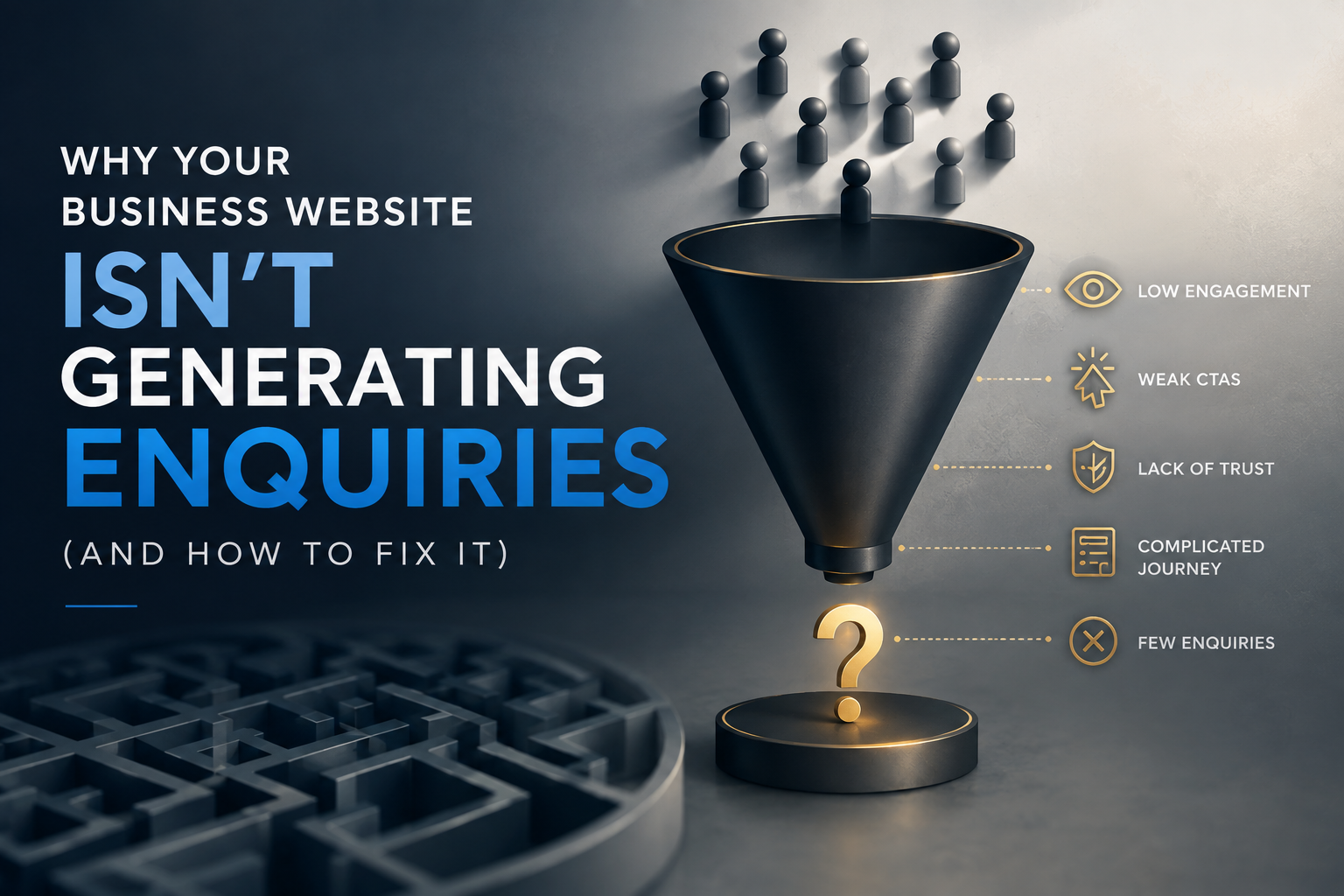
A business website can look professional, load correctly and contain all the expected pages — yet still generate very few enquiries.
When that happens, the problem is not necessarily a lack of traffic.
Often, the website is creating friction somewhere between a visitor arriving and deciding to take action.
That could mean an unclear offer, weak calls to action, difficult navigation, poor mobile usability or an enquiry process that simply asks too much of the customer.
What is stopping an interested visitor from becoming an enquiry?
This guide looks at some of the most common reasons business websites fail to generate leads — and what can be improved.
1. Visitors Cannot Immediately Understand What You Do
A visitor should not have to study your homepage to understand your business.
Within the first few seconds, they should be able to identify:
- what you offer
- who you serve
- why your business is relevant to them
- what they should do next
Generic headlines or broad claims without context rarely help someone make a decision.
Your main message should communicate the value of the business clearly.
A visitor who is confused is unlikely to continue searching for the answer.
2. Your Calls to Action Are Too Weak
A call to action tells the visitor what to do next.
Examples might include:
- Book an Appointment
- Request a Quote
- Get Started
- Enquire Now
- View Pricing
- Speak to Our Team
One of the most common website problems is making these actions difficult to find.
A strong call to action should appear naturally at important points throughout the customer journey.
That does not mean placing a button after every paragraph.
It means ensuring that when a visitor becomes ready to act, the next step is obvious.
3. The Customer Journey Has Too Many Steps
Every unnecessary step creates another opportunity for a potential customer to leave.
Long journey: Find the service → locate contact details → email the business → wait for a response → receive a booking link → return later → complete the booking
Short journey: Find the service → choose appointment → book → receive confirmation
The second journey removes unnecessary friction.
Review your website from the perspective of a first-time customer and ask:
How many actions does someone need to complete before they can become a lead or customer?
4. Your Service Pages Do Not Answer Enough Questions
Someone considering a service usually has questions before they are ready to enquire.
They may want to know:
- what the service includes
- who it is for
- how the process works
- how much it costs
- how long it takes
- what happens after booking
- whether your business is suitable for them
If the website provides almost no useful information and simply says “Contact us to learn more,” the visitor has to commit before receiving enough information to make a decision.
That can reduce enquiries.
Good service pages should remove uncertainty while naturally moving the visitor towards the next action.
5. There Is Not Enough Trust
Before someone sends an enquiry, books an appointment or makes a payment, they need confidence in the business.
Trust can be strengthened through appropriate signals such as:
- clear business information
- professional design
- genuine customer reviews
- team information
- relevant qualifications or accreditations
- transparent pricing where appropriate
- clear contact information
- policies
- case studies or examples of work
- secure website functionality
The specific trust signals required will depend on the industry.
The principle remains the same:
People are more likely to take action when uncertainty is reduced.
6. Your Website Is Difficult to Use on Mobile
A large proportion of potential customers will encounter your business from a mobile device.
That means the mobile journey cannot simply be a compressed version of the desktop site.
Check whether mobile visitors can comfortably:
- read the content
- navigate between services
- tap buttons
- complete forms
- book appointments
- view prices
- make payments
- find contact information
Small usability problems become much more noticeable on a phone.
7. Your Enquiry Form Is Asking for Too Much
Businesses often try to collect every possible piece of information in the initial enquiry form.
That can be counterproductive.
Someone making their first enquiry may not be ready to provide:
- extensive personal details
- detailed project specifications
- numerous required fields
- information they do not yet know
Ask only for what is genuinely required at that stage.
Additional information can often be collected after the initial enquiry.
The objective of the first form should usually be to make beginning the conversation straightforward.
8. Your Website Is Too Focused on the Business
Many websites are written almost entirely from the company’s perspective.
They talk extensively about:
- the company
- its history
- its process
- its achievements
- its products
Those things can matter.
But visitors are primarily asking:
Can this business solve my problem?
Effective website copy connects what the company offers to what the customer actually needs.
Instead of only describing features, explain the practical outcome those features create.
9. Your Pricing Creates Unnecessary Uncertainty
Not every business should publish exact prices.
Complex or highly bespoke work may require consultation before an accurate quote can be provided.
However, avoiding any discussion of cost can sometimes create more friction than necessary.
Depending on the business, this might be solved through:
- exact prices
- starting prices
- pricing ranges
- package levels
- examples of what affects cost
- clear explanation of the quotation process
The objective is to give customers enough information to understand whether the service is realistically suitable for them.
For more context, read How Much Does a Website Cost in the UK? or review AL Digital pricing.
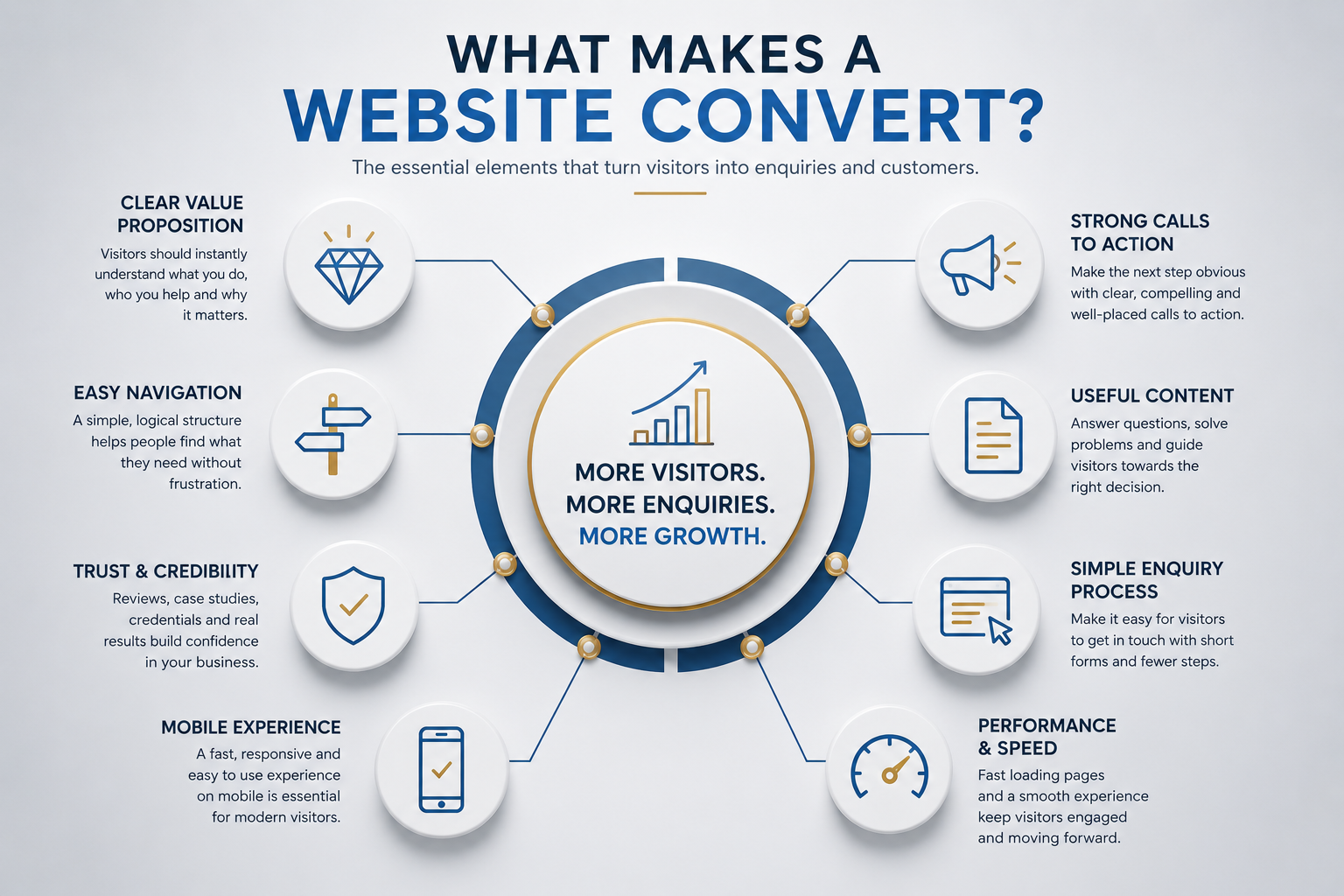
10. Your Website Looks Good but Has No Conversion Strategy
A visually impressive website can still perform poorly.
Good design should support the customer journey rather than compete with it.
Important pages should work together with a clear purpose:
How to Find Where Your Website Is Losing Customers
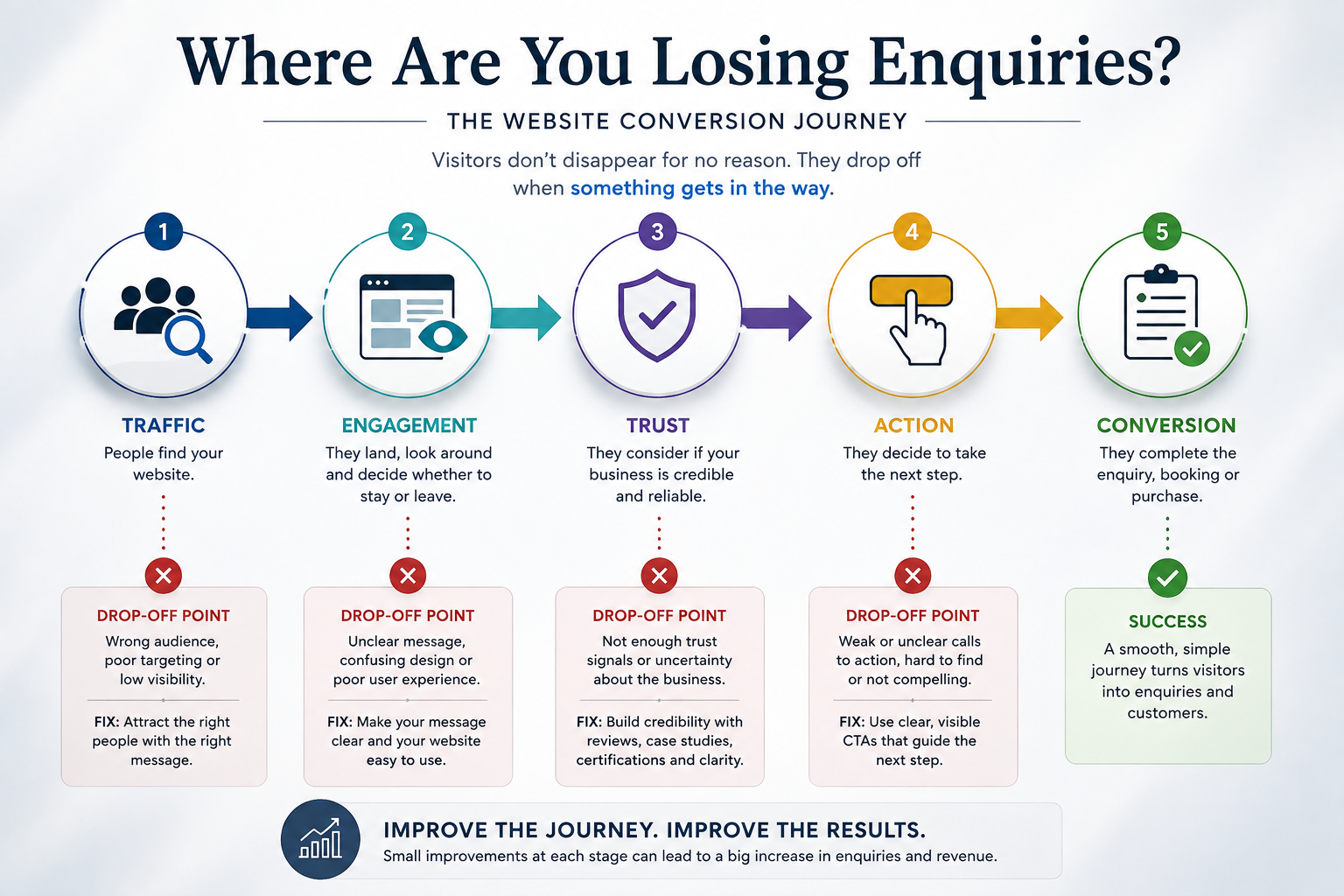
You do not always need to redesign the entire website. Start by identifying where the problem occurs.
Look at Your Traffic
If almost nobody visits the website, the problem may primarily be acquisition rather than conversion.
Improving the website alone will not solve a lack of visibility.
Look at What Visitors Do
Analytics and behavioural tools can help identify:
- which pages visitors enter
- where they leave
- which pages receive engagement
- which calls to action are used
- whether mobile users behave differently
- whether important pages are being ignored
Test the Journey Yourself
Choose one important service and pretend you are a completely new customer.
Find it → understand it → trust the business → enquire or book → complete the next step
Any point where you hesitate is worth investigating.
Test Forms and Booking Systems
Regularly check:
- contact forms
- confirmation messages
- notification emails
- booking links
- payment journeys
- mobile functionality
A broken form can make a functioning website commercially useless.
Should You Redesign the Website?
Not necessarily.
A complete redesign may make sense if the current website has fundamental problems involving:
- structure
- technology
- branding
- responsiveness
- scalability
- navigation
- integrations
- performance
But if the underlying website is sound, improving a few high-friction areas may produce a better commercial result than rebuilding everything.
The decision should be based on the problem rather than assuming a new website is always required.
If the platform itself may be part of the limitation, compare the options in Bespoke Website vs Website Builder.
A Better Way to Think About Website Performance
Instead of asking:
“Does my website look good?”
Ask:
“Does my website make it easy for the right customer to take the next step?”
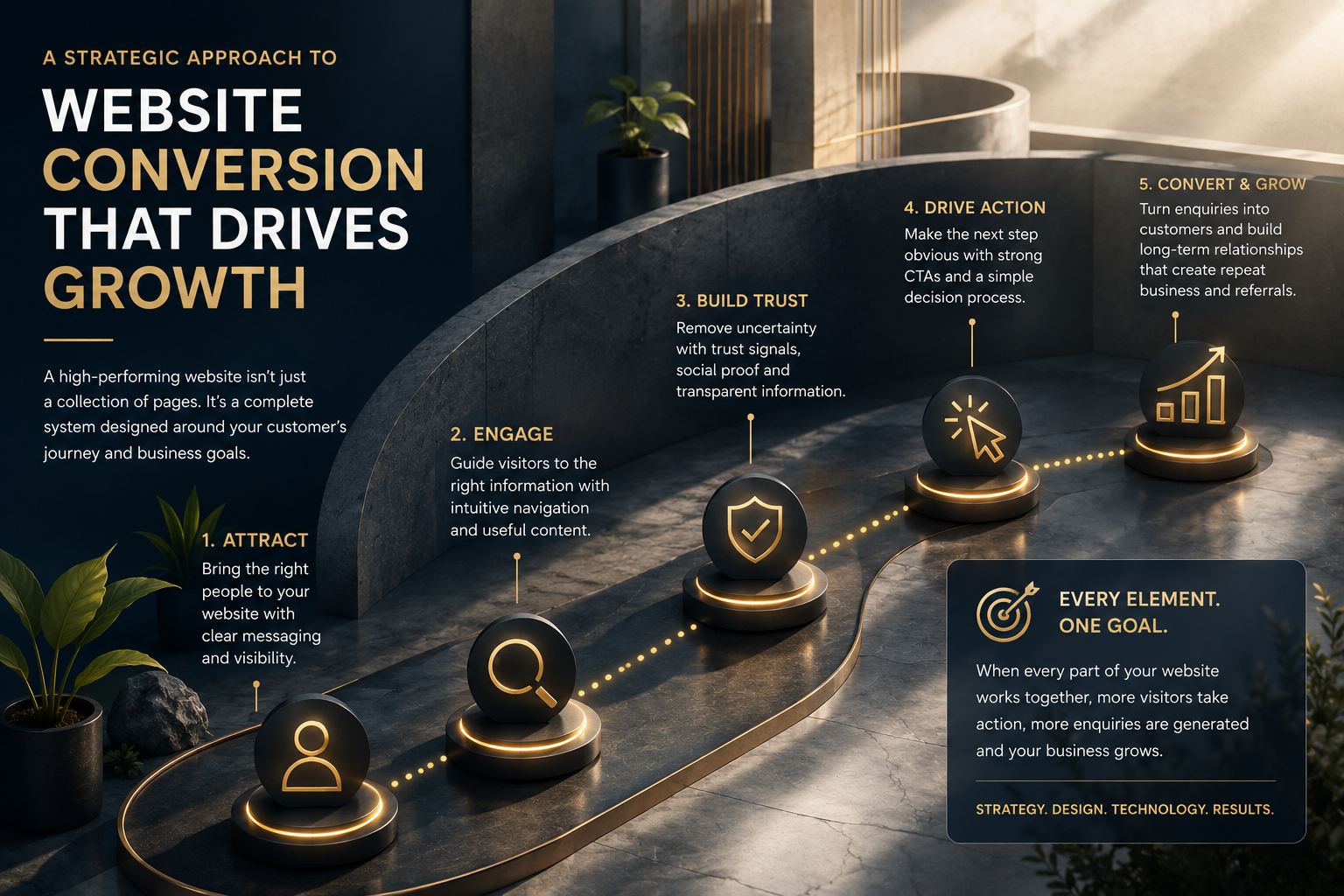
The focus should move from individual pages to the complete journey:
Every stage matters.
Website Enquiry Checklist
Review your website and ask:
- Can visitors immediately understand what the business offers?
- Is the main next step obvious?
- Are service pages informative?
- Is important pricing information clear where appropriate?
- Are there sufficient trust signals?
- Does the website work properly on mobile?
- Are forms quick and straightforward?
- Do booking and payment journeys work?
- Are calls to action positioned logically?
- Are there unnecessary steps?
- Are forms and notifications tested regularly?
- Does every important page have a clear purpose?
If several answers are no, the issue may not be that your business needs more website traffic.
It may be that the existing traffic is not being converted effectively.
Build Around the Customer Journey
The strongest business websites do not simply present information.
They guide people towards an outcome.
That could be:
- an enquiry
- an appointment
- a purchase
- a quote request
- a consultation
- another commercially valuable action
The website, content, forms, booking systems, payments and follow-up journey should support that outcome together.
Explore more practical guidance in the AL Digital Insights hub.
Is your website getting visitors but not enquiries?
AL Digital builds websites and connected digital systems around customer journeys, conversion and business requirements.
Explore Our Services Get a Free Quote